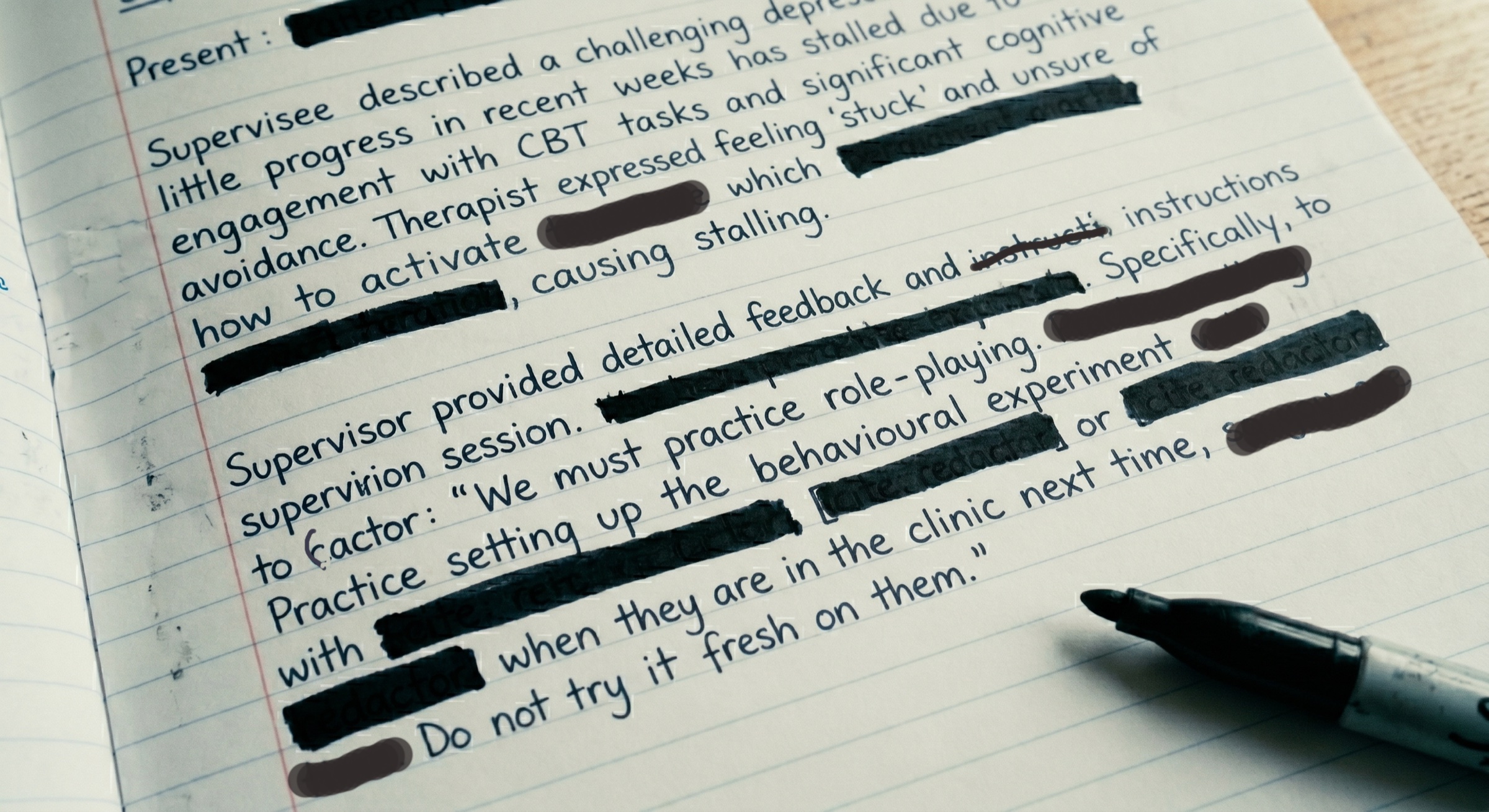
The supervisor's role in safeguarding is one of the more consequential aspects of supervisory practice and one of the less robustly instrumented. Most supervision records of safeguarding-relevant conversations live as free-text notes in whatever document the supervisor uses to capture sessions — sometimes structured, often not, retrievable in ways that range from "in three minutes" to "if I can remember which laptop I had at the time."
This is not, in itself, a sign of negligent supervisors. It is a sign that the standard supervision record-keeping tools were not designed with safeguarding audit trails in mind. The clinicians using them are doing the safeguarding work; the record-keeping is failing to instrument it in a form the regulatory frameworks have come to expect.
What safeguarding conversations in supervision actually look like
Most safeguarding-relevant moments in supervision arrive through a recognisable sequence. The supervisee raises a concern about a client — disclosed historical abuse, current risk of harm to self or another, a deteriorating dependent, a domestic situation unfolding in a way the supervisee is not sure how to read. The supervisor and supervisee discuss what is being held: the level of concern, the threshold for escalation against the relevant local framework, the specific actions, the timeline, the responsibilities. Who is going to call whom, by when. What the supervisee will document in their own clinical notes. What the supervisor will record in supervision.
The conversation has clinical, ethical, and regulatory dimensions at once. Each of the frameworks involved — BABCP standards for accredited members, HCPC standards for registered psychological professionals, BPS standards for psychologists in applied roles, NHS Safeguarding Adults Board guidance, NHS Children's Safeguarding guidance, and whichever local procedures apply — expects safeguarding decisions to be documented. None specify, in operational detail, what the supervision record of those decisions has to look like. The gap between "documented" as a general standard and "documented in a form that survives audit" is exactly where the standard record-keeping struggles.
What the record needs to capture
A safeguarding-relevant moment in supervision, captured well, includes more than the clinical content of the discussion. The fuller record holds the date and context, the specific concern raised in language a later reader would understand without having been in the room (generalities like "client expressed some concerning thoughts" are not enough; specifics — "client described intrusive thoughts of harming her infant son, with intensity rated at 7/10, occurring multiple times daily" — are what the record requires), the agreed assessment of level against the relevant safeguarding framework, the agreed actions with specificity (not "supervisee will follow up" but "supervisee will telephone the local safeguarding lead by 12:00 tomorrow, document the conversation in the client's clinical record, and contact the GP"), the responsibilities allocated, the follow-up date, and the eventual outcome of those actions — written in at the follow-up review rather than left as an open loop.
If safeguarding is later examined — at audit, fitness-to-practise review, or serious incident inquiry — this record is the principal evidence of what supervision contributed. Its quality is the supervisor's quality of practice, made retrievable.
Why free-text notes are not enough
Free-text supervision notes capture the content of these conversations, in most cases adequately. What they do not capture is the structure.
The auditor asking "show me your safeguarding decisions across the last six months" cannot easily extract them from a stack of free-text supervision notes. The supervisor faced with that request begins searching — opening file after file, scanning for the word "safeguarding" or "risk" or a client's name vaguely remembered. Some records will be findable. Others will be in files saved with names that no longer correspond to any obvious search. A few will be on a laptop the supervisor no longer has, a USB drive that was never properly transferred, or a notebook that may or may not still be in a drawer somewhere.
The supervisor's response — searching, hoping, sometimes successfully retrieving — is not what the regulatory frameworks have in mind when they specify "documented" supervision arrangements. They imagine a record that can be produced on demand, organised by date and category, complete across the period of interest. This is not a complaint about supervisors. It is an observation about the gap between the record-keeping tools the field has settled on and the audit-retrievability the regulatory frameworks have come to expect. The free-text supervision note was a reasonable tool when supervision was an internal craft conversation. It is a less reasonable tool now that the same conversations are also audit-trail artefacts.
The connection to the contract
The supervision contract is where the record-keeping arrangements should be specified — what gets recorded, where it lives, who has access, the retention period, the audit pathway. This is part of why the supervision contracts piece treats the contract as load-bearing rather than ceremonial: the contract is not separate from the record-keeping; the record-keeping is one of its clauses.
A supervision contract that does not specify how safeguarding moments are recorded has decided to leave the record-keeping to whatever the supervisor happens to do that week. The supervisee, faced later with any question about what was discussed in supervision and what was agreed, has no reference point beyond the supervisor's own notes — and if those notes were never structured around safeguarding as a distinct stream, the supervisee's evidence base is thinner than it could have been.
The drift connection is also worth naming briefly. The therapist drift literature documents how qualified clinicians move away from evidence-based practice when fidelity-supporting structures are not in place. Safeguarding practice in supervision is structurally similar. A supervisor with no documented safeguarding-record clause is a supervisor whose attention to the safeguarding stream depends on the supervisee mentioning it; a supervisor whose record-keeping captures safeguarding decisions only when they happen to be flagged in free-text notes is a supervisor whose audit-readiness depends on whether the right keywords appear in the right files. Neither is a failing of intent. Both are failings of infrastructure.
What good safeguarding-record infrastructure looks like
The features are not exotic. They become unusual mainly because the standard supervision record-keeping tools are not built around them.
Structured tagging of safeguarding-relevant moments in supervision. When a safeguarding concern is raised in a session, the relevant portion of the supervision record is tagged as such — not as a manual exercise the supervisor may or may not remember to do, but as a structured prompt in the record-keeping tool itself. The tag carries the metadata that lets the record be retrieved: date, supervisee, client identifier (in whatever pseudonymised form the service requires), level of concern, framework against which it was assessed.
Linked records. The supervision episode, the concern, the agreed actions, the follow-up, and the eventual outcome are held together as a linked sequence rather than scattered across separate session notes. The supervisor reviewing a safeguarding decision six months later does not need to reconstruct the chain by reading three separate session notes; the linked sequence is the record.
Audit-ready exports. When asked — by an internal audit, by a fitness-to-practise review, by a serious incident inquiry — the supervisor can produce the safeguarding strand of their supervision practice across an arbitrary date range. The export is the record; the record is not constructed from a search-and-hope across free-text notes.
Retention and access arrangements specified in the contract. Who can see the safeguarding record, under what circumstances, for how long it is kept, what happens at the end of the supervisory relationship and at the end of the retention period. These are clauses in the contract, not improvised decisions at the moment they are asked.
Cross-reference to the supervisee's own clinical record. The supervision record of a safeguarding decision references the supervisee's own clinical record of the same client — confirming that the action agreed in supervision was logged in the client's record by the supervisee, that the safeguarding referral was made on the timeline agreed, that the GP communication happened. The two records sit alongside each other rather than as independent artefacts.
None of these features are intellectually mysterious. They require a record-keeping infrastructure that prompts for them at the point of entry — without which, the prompting is left to the supervisor's own discipline, and the discipline is the variable the field is least entitled to assume is uniformly high.
The cost of not having this
The cost is asymmetric. In most months, in most supervisory relationships, the absence of structured safeguarding records makes no operational difference. The conversations happened, the actions were taken, the outcomes were what they should have been. No one asks.
In the month when something does go wrong — when a serious incident review opens, when a fitness-to-practise concern arrives, when a client outcome later prompts an audit — the absence of structured records is what the supervisor has to defend their practice against. The supervisor's account becomes the only evidence of the conversation. The free-text notes, when retrievable, support some of the account but not all of it. The agreed actions were either documented somewhere the supervisor cannot now find or were never written down with enough specificity to demonstrate that the right thing was agreed.
This is the position any responsible supervisor would prefer not to be in. It is also, in the field as it currently operates, the default position the standard record-keeping tools leave supervisors in. The structural fix is not to write more careful free-text notes — supervisors are already writing careful free-text notes — but to instrument the safeguarding stream as a structured stream, with the tagging, linking, and export workflows that turn an audit request from "let me search" into "here is the export."
The labour cost of building this once is small relative to the labour cost of reconstructing safeguarding records under audit pressure. The infrastructural cost is small relative to the consequences of being unable to produce them at all.
Supervisia's supervision pathway tags safeguarding moments as a structured stream.
Safeguarding-relevant portions of supervision are tagged at the point of entry, with episode, concern, agreed actions, responsibilities, follow-up, and outcome held together as linked records. Audit-ready exports produce the safeguarding strand of supervision practice across any date range without reconstruction. The contract structure specifies retention and access arrangements alongside the record-keeping itself, so the regulatory expectations and the supervisor's actual practice are held in the same document rather than living separately.
References
- BABCP. Standards of Conduct, Performance and Ethics. British Association for Behavioural and Cognitive Psychotherapies, current edition.
- BABCP. Criteria for Accreditation as a CBT Supervisor. British Association for Behavioural and Cognitive Psychotherapies, current edition.
- HCPC. Standards of Conduct, Performance and Ethics. Health and Care Professions Council.
- BPS. Practice Guidelines for Psychologists. British Psychological Society, current edition.
- NHS Safeguarding Adults Board. Safeguarding Adults: Multi-Agency Policy and Procedures.
- NHS. Working Together to Safeguard Children: Statutory Guidance on Inter-Agency Working to Safeguard and Promote the Welfare of Children.
- Waller, G. & Turner, H. (2016). Therapist drift redux: Why well-meaning clinicians fail to deliver evidence-based therapy, and how to get back on track. Behaviour Research and Therapy, 77, 129–137. DOI: 10.1016/j.brat.2016.01.007. PubMed: 26752326.
Last updated: May 2026