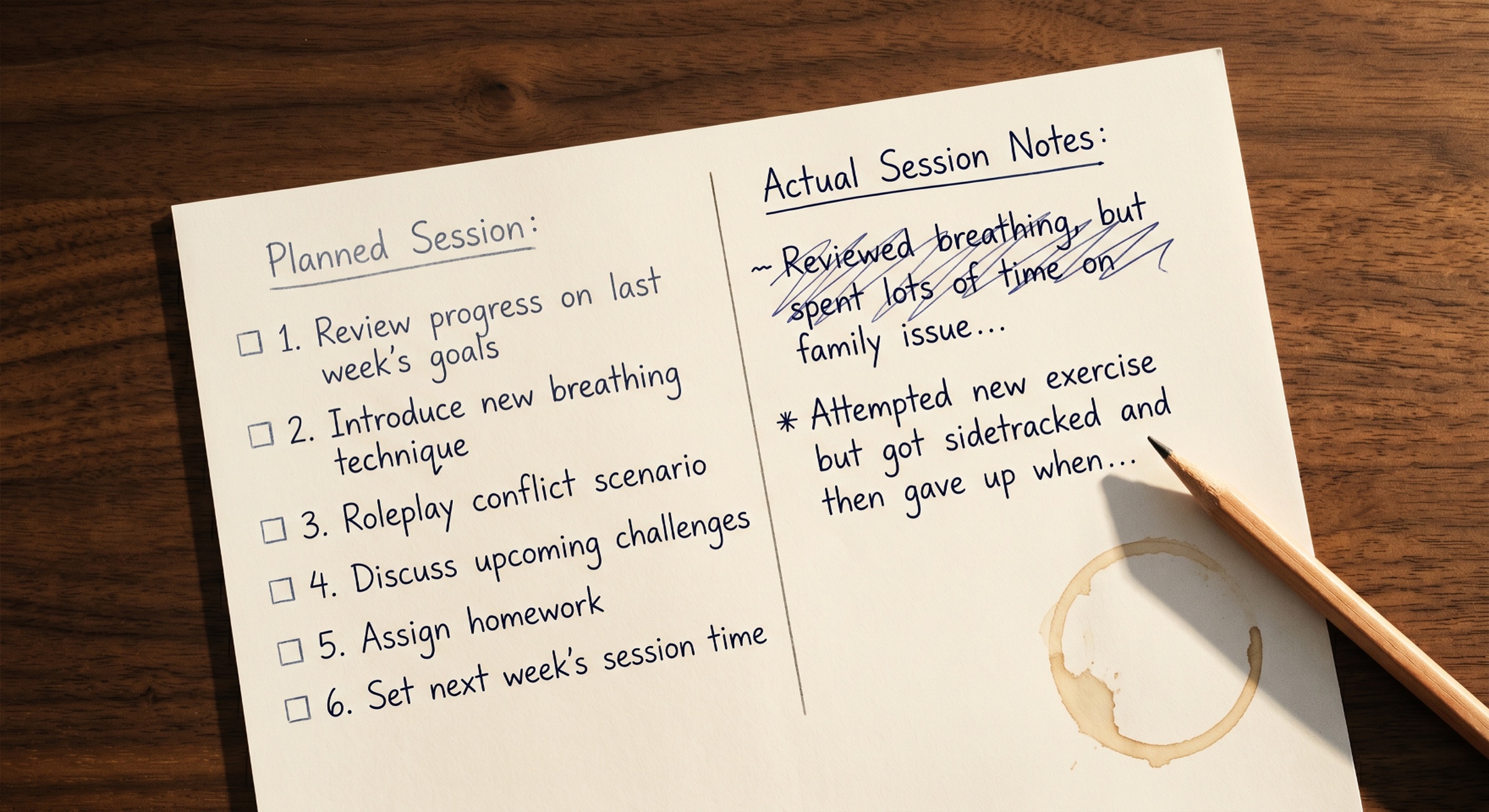
There is a particular kind of professional discomfort that comes from reading certain papers in the CBT literature. Not the discomfort of encountering a difficult idea — that's the easy kind. The discomfort of recognising something familiar about your own practice and watching a paper name it with clinical precision.
The literature on therapist drift is that kind of reading.
What therapist drift actually is
Therapist drift is the phenomenon where qualified therapists move away from the evidence-based techniques they were trained to deliver, even when they have the resources, the training, and the presenting problem that calls for those techniques.
The term has been in the CBT literature since at least 2009. But the most comprehensive statement of the problem came in a 2016 review by Glen Waller and Hannah Turner: Therapist drift redux: Why well-meaning clinicians fail to deliver evidence-based therapy, and how to get back on track.
Their framing is worth quoting directly. Drift is not, they argue, best understood as incompetence or laziness. It is shaped by "ordinary human factors — beliefs, emotions, habits, and social context." Clinicians drift not because they have forgotten what to do, but because the doing of evidence-based therapy is uncomfortable, demanding, and — without external structures in place — progressively harder to sustain.
The word "redux" in the title is doing quiet but important work. They are not announcing a new problem. They are noting that the field identified this problem, documented it, and then largely continued as before.
It is not occasional. It is structural.
This is the part that tends to land hardest.
The exposure literature is the most documented example. Imaginal exposure for PTSD is, by broad consensus, one of the most effective psychological interventions available for that presentation. It is also severely underutilised by qualified, trained therapists — including therapists who report believing in the technique. The same pattern appears in exposure-based protocols for anxiety disorders, where therapists routinely deliver fewer exposures at lower intensity than the evidence base recommends, and where the gap between what therapists say they do and what they actually do in session is consistently large.
Eating disorders present a particularly well-documented case. Research in this area has repeatedly shown that clinicians working in ED services are often aware of evidence-based approaches, can describe them accurately, and still do not deliver them in practice. The knowing and the doing come apart.
Waller and Turner's analysis of why this happens identifies several converging factors:
Therapist beliefs. Clinicians hold beliefs about specific techniques — that exposure is too distressing, that pushing for behavioural experiments is "forcing" the client, that the client "isn't ready." These beliefs are often not examined; they operate as background assumptions that quietly shape what gets done in the room.
Emotional avoidance. Some techniques require the therapist to tolerate distress — their own as well as the client's. Sitting with a client who is distressed during imaginal exposure, or challenging a strongly held belief when the client is fragile, demands a specific kind of professional tolerance. When that tolerance is not actively maintained, the path of least resistance is to do something that feels safer.
Habit and social context. Practice drifts toward the habitual. Therapists treat more clients using approaches they have used before, modify techniques to fit their natural style, and take implicit cues from team culture about what is "normal" practice. None of these processes are conspicuous. They accumulate.
The self-assessment problem
Here is where it gets structurally interesting.
If therapists are drifting — moving away from the evidence base in ways shaped by beliefs, emotions, and habit — then the question is: how do they know? The honest answer from the literature is: they largely don't.
Walfish and colleagues published a study in 2012 examining self-assessment bias in mental health providers. The finding is famous enough now to have entered the standard lecture on clinical humility: the great majority of therapists in their sample rated their skill as "well above average." Statistically, half of any sample must fall in the bottom half. Walfish's bottom half consisted, in effect, of about three people.
This is not a finding about dishonesty or arrogance. It is a finding about the limits of self-monitoring as a quality-assurance mechanism. The same cognitive processes that allow a therapist to function efficiently in the room — pattern recognition, fluency, accumulated implicit knowledge — also make it genuinely difficult to observe one's own practice from the outside.
Walfish et al. (2012) were studying self-assessment generally, but the implication for drift is direct: if therapists cannot reliably assess their own overall competence level, they are even less likely to notice the gradual, technique-level drift that Waller and Turner describe. The drift feels like clinical flexibility. It feels like experience. It feels, if it feels like anything at all, like good practice.
This is why self-report cannot be the fidelity instrument.
Why training alone doesn't fix it
The response to drift, when it is acknowledged, is often more training. Continuing professional development days, competency workshops, online modules. These have real value — a clinician who has never heard of prolonged exposure cannot deliver it — but the literature is fairly consistent that one-off training events do not solve the behaviour-maintenance problem.
Drift is not primarily a knowledge gap. Therapists who drift usually know what the evidence base recommends. What they lack is the ongoing structure that keeps behaviour aligned with knowledge.
This is a familiar enough idea from any other area of behavioural change. We do not treat a patient's unhealthy habits by telling them once what the right behaviour looks like and expecting the change to persist without support. We build reinforcement structures, feedback loops, accountability mechanisms. The same logic applies to the clinician's own behaviour.
The evidence on what actually moves the needle is instructive. Structured CBT supervision improves CTS-R competence ratings over time — Liness and colleagues' 2019 study demonstrated this in a single-case experimental design, with competence improving across the supervision period and the gains specific to the supervised skills (PubMed: 32213046). The mechanism matters: not supervision as case-discussion, but supervision as a structured, fidelity-referenced feedback loop.
Bearman and colleagues' 2022 randomised trial tackled the measurement side of the same problem. They compared methods of measuring therapist adherence and found that behavioural rehearsal aligned with direct observation as a fidelity measurement approach — and that therapist self-report significantly overestimated adherence relative to observed behaviour (PubMed: 36229116). In other words, the gap between what therapists think they do and what they actually do is not just an artefact of the Walfish paper. It shows up in adherence measurement too.
What the literature suggests works
The picture that emerges from the drift and supervision literature is not complicated, though it is demanding:
External observation matters. Competence measured by self-report and competence measured by observed performance are not the same thing. Sustained fidelity requires some mechanism of external, structured observation — not as a performance review, but as the normal infrastructure of practice.
Feedback needs to be timely and specific. General supervisory encouragement ("you're doing well") does not move the same levers as specific, technique-level feedback referenced to a competency framework. The CTS-R exists precisely because it structures the conversation around specific, observable behaviours rather than global impressions.
Behavioural rehearsal has a role. Bearman et al.'s finding that behavioural rehearsal aligns with direct observation as a fidelity mechanism suggests that practising specific techniques — not just reflecting on them — is part of maintaining competence. Deliberate practice for therapists, not merely for trainees.
The structure needs to be ongoing. One supervision session does not counter fifteen years of habit. The research on competence development consistently points toward continuous feedback structures rather than periodic intervention.
This connects directly to the deliberate practice literature — the evidence that highly effective psychotherapists invest systematically in structured, feedback-loaded practice across their careers. That is a separate argument, explored in detail in the deliberate practice article, but the bridge between the two is clear: the antidote to drift is not more knowledge. It is better practice infrastructure.
The implication for individual therapists
There is an uncomfortable conclusion embedded in all of this.
If you qualified, completed your initial training, and have not built ongoing structures for external observation and fidelity feedback into your practice — you are, statistically, likely to have drifted. Not because you are a bad clinician. Not because you don't care about the evidence base. But because drift is the default outcome of practice without feedback, and the self-monitoring tools available to most therapists are not sensitive enough to detect it reliably.
The professional response to this is not self-flagellation. It is the same response you would recommend to a client who discovers their thinking has been biased by an unhelpful assumption: acknowledge it, build in a corrective mechanism, and move forward with better structures.
The question is not whether you have drifted. It is whether you have a system that would tell you.
Supervisia exists because of this problem.
The Train pathway gives you AI clients to practise on, CTS-R scoring on every drill, and trainer commentary that does the work of in-the-moment technique-level feedback. The techniques you have been quietly avoiding — exposure, behavioural experiments, the harder Socratic sequences — are exactly the ones you can drill, with feedback, between supervision sessions. The drift literature does not let any of us off lightly. The infrastructure has to exist somewhere.
References
- Waller, G. & Turner, H. (2016). Therapist drift redux: Why well-meaning clinicians fail to deliver evidence-based therapy, and how to get back on track. Behaviour Research and Therapy, 77, 129–137. PubMed: 26752326. DOI: 10.1016/j.brat.2016.01.007
- Walfish, S., McAlister, B., O'Donnell, P. & Lambert, M. J. (2012). An investigation of self-assessment bias in mental health providers. Psychological Reports, 110(2), 639–644. DOI: 10.2466/02.07.17.PR0.110.2.639-644
- Liness, S. et al. (2019). Clinical supervision in cognitive behavior therapy improves therapists' competence: A single-case experimental pilot study. PubMed: 32213046.
- Bearman, S. K. et al. (2022). A randomized trial to identify accurate measurement methods for adherence to cognitive-behavioral therapy. PubMed: 36229116.
Last updated: May 2026