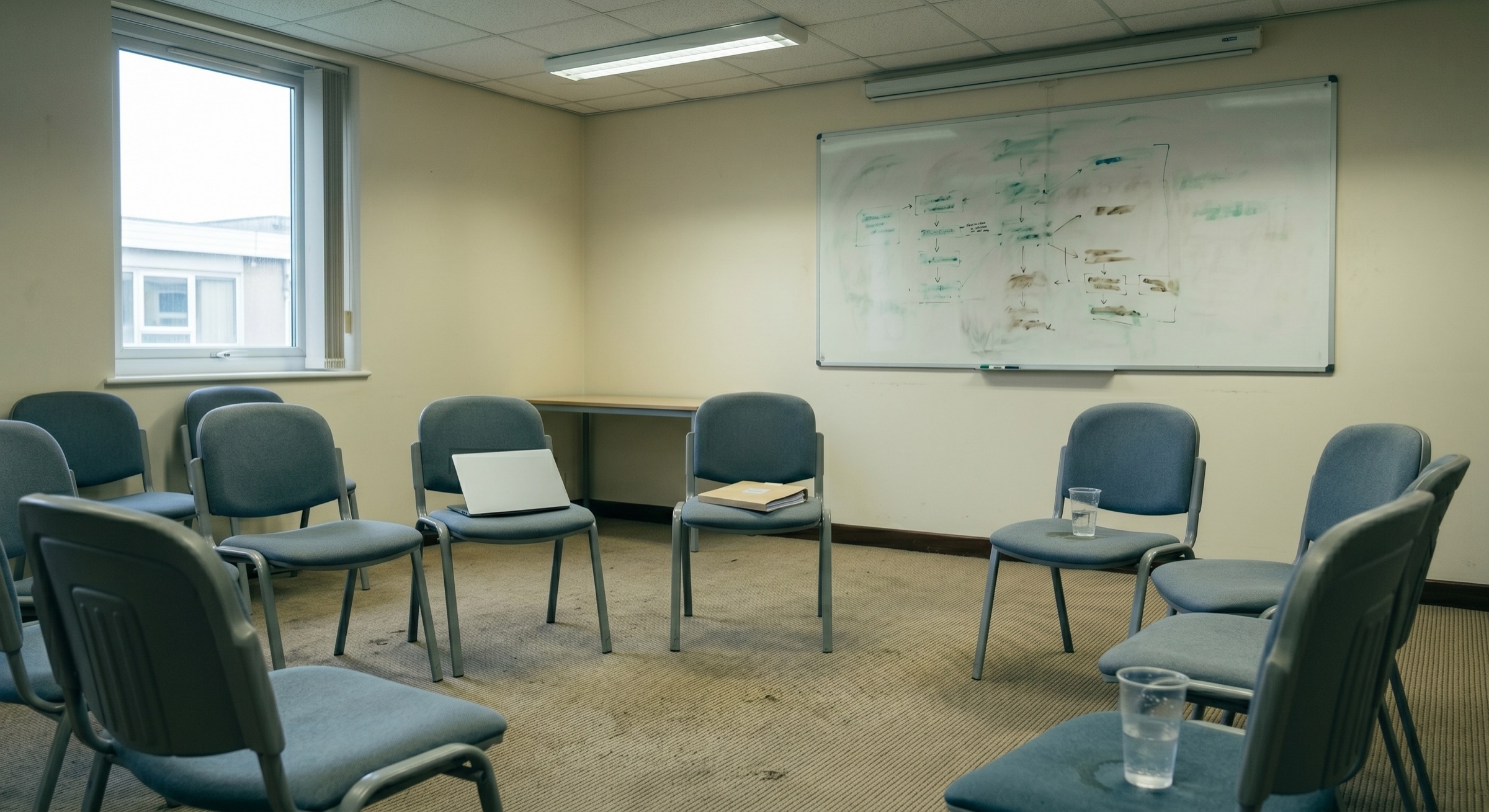
Group supervision is, by some distance, the most common form of supervision delivered in NHS Talking Therapies. It is also one of the least examined. It exists in the workforce because it works under specific constraints — one supervisor, multiple supervisees, time scarcity, and a service-level throughput problem that individual supervision at the BABCP-preferred cadence cannot solve at scale. It does not exist because anyone thinks it is the optimal mode of supervision. Both of those things are worth taking seriously at once.
Group supervision is a distinct modality with its own strengths, its own characteristic failure modes, and a set of operational requirements that look different from those of individual supervision. The supervisors who run it well have noticed those differences. The supervisors who run it badly are, mostly, treating it as a smaller version of individual supervision delivered to several people at once.
What group supervision actually is in NHS Talking Therapies
The NHS Talking Therapies Manual specifies group supervision as the standard model in Step 2 (low-intensity, PWP-delivered) services. The structure is reasonably consistent across services: a single supervisor, typically three to six supervisees, meeting fortnightly or monthly, with each session organised around case presentations rotated through the group. The supervisor is responsible for fidelity feedback on the cases presented and — this is the part that is often left implicit — for the cases that are not.
In Step 3 (high-intensity, CBT-delivered) services, group supervision is widely used but the picture is more mixed. Some services run pure group supervision; many run a hybrid, with individual supervision held alongside the group at a lower cadence and cases shifted between formats depending on what is needed. Trainee CBT therapists on training routes typically receive a mix, with proportions specified by the training programme rather than the service.
The BABCP supervisor accreditation criteria — addressed in the accreditation portfolio article — count group supervision separately from individual supervision, and supervisors seeking accreditation are expected to evidence hours across the modalities they wish to be accredited for. Group supervision is, in that sense, a recognised modality with its own evidence base, not a downgraded form of individual supervision.
Why the workforce relies on it
The reason is throughput, and the arithmetic is unforgiving.
A Step 2 service might have twenty PWPs each carrying low-intensity caseloads. BABCP cadence preferences — particularly for newly qualified or in-training clinicians — would, if applied through individual supervision alone, require several full-time supervisor posts. Most services do not have that capacity. Group supervision allows one supervisor to cover the throughput of three or four, which is what makes the service-level arithmetic close. The same constraint operates, in attenuated form, at Step 3.
This is not a critique. It is the operational reality the modality is designed for. The point worth being clear about is that group supervision was selected to fit the workforce, not because comparative-effectiveness research established it as the preferred form. Once that is clear, the question of how to run it well becomes the right question to be asking.
The well-documented limitations
Group supervision has characteristic failure modes that are visible in the field and recognisable to anyone who has run or attended it. The honest list is short and worth being explicit about.
Case selection bias. Case presentation in group format selects for the cases the supervisee feels safe presenting. The supervisee is, in effect, performing professional self-presentation in front of peers as well as the supervisor. The cases that go wrong — dropouts, lack of progress, safeguarding edges, the clients the supervisee is privately worried about — are systematically under-presented. They appear, but at lower rates than they would in individual supervision where the social cost of presenting a difficult case is lower.
Sample-of-practice problem. The supervisor sees a small fraction of each supervisee's caseload — the cases that get presented, in the order they get presented, filtered by what the supervisee thinks is worth bringing. Drift signals, the kind that the therapist drift literature identifies as the structural threat to maintained competence, are easier to miss in this format because the supervisor is working from a filtered sample.
Group-level versus supervisee-level signal. Group supervision is good at surfacing patterns that operate across the group — common formulation gaps, service-level issues. It is much weaker at surfacing patterns that operate within an individual supervisee's caseload, such as the systematic way one PWP under-uses behavioural activation, or the way one CBT therapist tends to soften exposure when the client becomes distressed. Those patterns require seeing more of the individual's work than group presentation provides.
Reduced challenge density per supervisee. A ninety-minute group session shared between four supervisees gives each roughly twenty minutes of direct supervisory attention. The peer observation is itself of value, but the direct feedback density is substantially lower than an individual session of the same length.
These limitations are arguments for being clear about what group supervision is good for, and for adding the infrastructure that covers the bits group supervision predictably misses — not for replacing it with a modality the workforce arithmetic cannot support.
What group supervision is genuinely good for
The honest case for group supervision, run well, is not that it is a smaller version of individual supervision. It is that it does some things individual supervision cannot.
Peer learning across the group. When supervisee A presents a case where the client is stuck in avoidance, and supervisee B realises mid-presentation that this is the same pattern they have been struggling with, something has happened that individual supervision cannot produce. The group format generates lateral learning at a density individual supervision cannot match. A supervisor who recognises this and orchestrates it deliberately — drawing connections, asking what the presented case prompts in others' caseloads — is using the format for what it is good for.
Modelling of formulation and feedback. When the supervisor reasons aloud through a formulation, or delivers structured feedback on a recorded session excerpt, the entire group watches the reasoning happen. Supervisees learn how an experienced supervisor thinks about a case, how feedback is structured, what the supervisor attends to. The same demonstration in individual supervision reaches one person.
Reduction in supervisee isolation. Step 2 PWPs in particular often work in high-volume, emotionally taxing settings with little structural contact with peers. Group supervision is one of the few professional spaces where that work is normalised collectively rather than carried alone. The restorative function of supervision, in Proctor's terms, is delivered more effectively in group format than in individual for many supervisees.
These are reasons to run group supervision deliberately as group supervision, not as a degraded substitute for individual supervision.
What good group supervision looks like operationally
The supervisors who run group supervision well tend to have a recognisable set of operational practices in place.
An agreed rotation so each supervisee presents at known intervals. Not ad hoc — "who's got a case to bring this week?" — but a published rotation where each supervisee knows when they are next up and prepares accordingly. The rotation reduces case-selection bias and reduces the implicit cost of presenting a difficult case, because it is the supervisee's scheduled turn rather than a voluntary admission of struggle.
Structured case-presentation templates. A consistent template — presenting concern, formulation, intervention plan, what has happened, what is stuck, specific supervisory question — produces presentations that are usable by the rest of the group rather than narrative accounts that consume time without producing learning. Templates anchored against a competency framework (CTS-R for CBT, equivalent for low-intensity work) sharpen feedback toward technique-level observations rather than general impressions.
Explicit attention to which cases are not being presented. This is the practice that most distinguishes well-run group supervision from poorly-run group supervision. The supervisor periodically asks — outside of the rotation — what each supervisee is not presenting. The cases the supervisee is privately worried about. The cases that are stuck. The cases where outcomes data has been flat for three sessions. Without this practice, the group format quietly drifts toward presenting what is presentable.
Supplementation with some form of individual contact. Even brief, even monthly. A fifteen-minute individual check-in covers the case material genuinely unsuitable for group format — safeguarding edges, the supervisee's developmental concerns, cases where the issue is the supervisee's own response to the work. The hybrid is the structural acknowledgement that group supervision is a particular tool with particular strengths, not a universal solvent.
Outcomes-data review across the group. PHQ-9 and GAD-7 trajectories, dropout rates, recovery rates across the supervisees' caseloads should be visible to the supervisor outside of individual case presentations. A supervisee whose recovery rates have been trending downward is not going to present that as a case. The supervisor needs to see it from elsewhere and bring it into the conversation.
The contract connection
The supervision contract, addressed in the contracts article, is where the group / individual mix should live. A contract that specifies only "group, fortnightly, ninety minutes" has not done the contract-level work the group format requires.
The clauses that belong in a group-supervision contract include the rotation frequency and presentation schedule, the cases that trigger out-of-rotation discussion (safeguarding, fitness-to-practise, outcomes-trajectory concerns, requests for individual time), the supervisor's responsibilities to non-presenting supervisees, and the supplementary individual contact arrangements where they exist. A contract that names these things makes the modality work as designed. A contract that does not is leaving the difficult bits to be improvised, which is exactly what produces the failure modes the modality is known for.
The honest summary
Group supervision is the dominant supervision modality in NHS Talking Therapies and is, in practice, here to stay. The throughput arithmetic that produced it has not changed and is not going to. The question is how to use it well, and the supervisors who use it well are running it as a distinct modality with distinct strengths and operational requirements, not as a smaller version of individual supervision.
Done well, it delivers peer learning, formulation modelling, and restorative function that individual supervision cannot match. Done badly, it delivers a filtered view of each supervisee's practice in which the difficult cases quietly do not appear. The difference between the two is operational.
Supervisia's supervision pathway is built for this modality, not in spite of it.
The supervision pathway handles group-supervision rotations as a first-class concept — published presentation schedules, structured case-presentation templates anchored to competency frameworks, and the cross-supervisee fidelity tracking that lets the supervisor see what is and is not being presented across the group's caseload. Supervisee-level outcomes data, CTS-R review history, and individual development notes are held alongside the group structure, so the supervisor sees the bits group supervision does not surface on its own.
References
- NHS England. The NHS Talking Therapies, for anxiety and depression, Manual. NHS England, current edition.
- British Association for Behavioural and Cognitive Psychotherapies. Criteria for Accreditation as a CBT Supervisor. BABCP, current edition.
- Proctor, B. (1986). Supervision: a co-operative exercise in accountability. In M. Marken & M. Payne (Eds.), Enabling and Ensuring: Supervision in Practice. National Youth Bureau.
- Waller, G. & Turner, H. (2016). Therapist drift redux: Why well-meaning clinicians fail to deliver evidence-based therapy, and how to get back on track. Behaviour Research and Therapy, 77, 129–137. DOI: 10.1016/j.brat.2016.01.007. PubMed: 26752326.
- Liness, S. et al. (2019). Clinical supervision in cognitive behavior therapy improves therapists' competence: A single-case experimental pilot study. PubMed: 32213046.
Last updated: May 2026