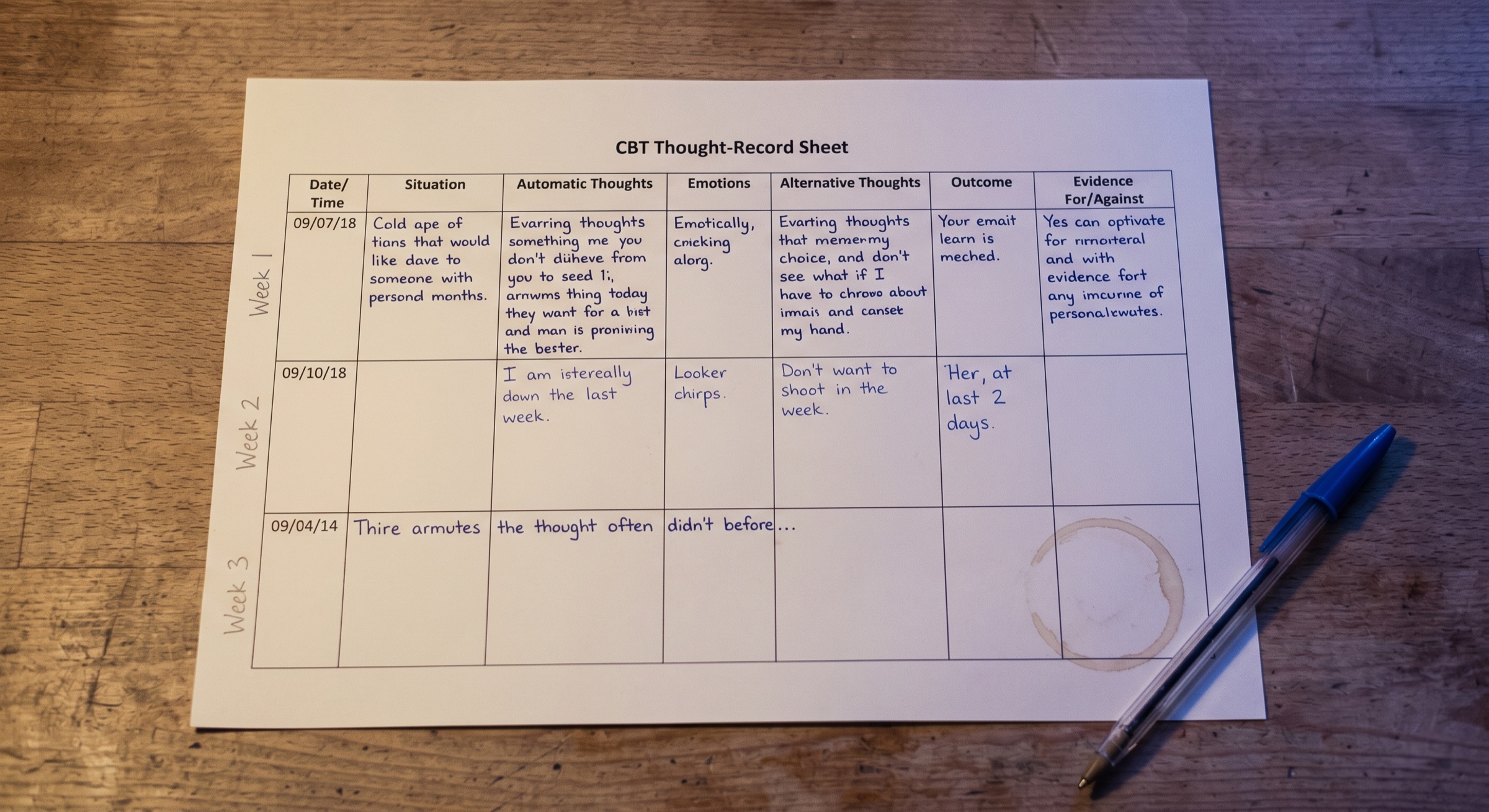
The variance in CBT outcomes is larger than the field tends to admit in public. Two qualified therapists working from the same manual, with comparable caseloads and similar training pedigree, will produce visibly different effect sizes over the course of a year. Some of that variance is unavoidable — patient mix, comorbidity, life circumstance. A great deal of it is not.
A surprising amount of it tracks one variable that almost every CBT therapist controls: whether the client actually does the between-session work, and whether the therapist treats that work as the substance of therapy rather than a postscript to it.
What Kazantzis 2016 actually found
Nikolaos Kazantzis and colleagues' 2016 meta-analysis in Behavior Therapy is the most rigorous synthesis of the homework-outcome relationship the field has. They pooled 23 studies involving roughly two thousand CBT participants and measured both the quantity of homework completed and the quality of that completion against post-treatment outcomes.
The headline numbers were not dramatic and that is part of why they matter. Quantity of homework compliance correlated with outcome at r ≈ .18. Quality of compliance — meaning the depth, accuracy, and engagement of the work, not just whether the worksheet got filled in — correlated at r ≈ .26. Both effects were statistically robust across the included studies.
It is worth pausing on the size of that quality effect. An r of around .26, from a variable the therapist genuinely controls, is unusual. A great deal of the rest of the CBT outcome variance is in factors that move slowly or not at all: years of experience accounts for less than this; theoretical orientation refinements account for less; even working-alliance ratings, much-cited in the common-factors literature, do not consistently outperform homework when measured cleanly.
In other words, what is sitting on the table here is one of the most controllable, most replicable, most actionable predictors of CBT outcome that we have. It is not a glamorous finding. It is a finding about whether the homework gets done and whether the therapist takes it seriously when it does.
Why this lands differently than it reads
The instinct on first encountering this evidence is to nod, acknowledge it, and move on. Of course homework matters. Everyone knows that. The instinct is wrong, and the reason it is wrong is the gap between knowing the literature and translating it into practice behaviour.
Routine CBT, judging from what the qualitative literature suggests and from any honest conversation between qualified clinicians, treats homework as the part of the protocol most likely to be quietly downgraded under pressure. Sessions overrun, something else takes priority, the homework gets set with insufficient detail or insufficient time. The next session opens with a case update, the homework review is folded into general discussion or skipped, and the implicit signal to the client — irrespective of what the therapist explicitly says — is that the work between sessions is optional preparation, not where the therapy mostly happens.
This is its own form of therapist drift. Not drift away from a technique, but drift in the structural weight assigned to a part of the protocol the evidence says should carry a lot. The drift literature consistently finds that the gap is rarely about therapists not knowing what to do; it is about the absence of structures that maintain the doing. The same gap appears here. The therapist who skips homework review in a busy week is not a therapist who has forgotten that homework matters. They are a therapist whose practice has no structural cushion against the busy week.
What shapes whether the homework actually gets done
LeBeau and colleagues' 2013 paper in Cognitive Behaviour Therapy extended the homework-outcome work by looking at what predicts compliance itself. They confirmed the basic effect — homework compliance counts — and went on to identify the variables that distinguish clients who do the work from those who do not. The variables that mattered most were not patient characteristics. They were features of how the homework was assigned.
Specificity of the task. Clarity of the rationale tying the task to the formulation. Realistic calibration of the difficulty. Whether the therapist had walked through the homework in session — sometimes literally rehearsing it — rather than describing it in the closing minutes and hoping for the best.
Callan and colleagues' 2019 propensity-score analysis in Behavior Therapy takes the argument a step further. Using a more rigorous causal-inference approach than standard correlational designs, they confirmed that homework adherence is a meaningful predictor of outcome in CBT for depression, and demonstrated that this effect survives adjustment for the kind of selection bias that bedevils naturalistic studies — that is, the worry that "more compliant clients" might just be "clients who were going to improve anyway."
The Callan paper also draws attention to the therapist's behaviour at review. The compliance effect is not just about whether the client did something between sessions. It is about what happens when they come back. Whether the therapist treats the homework as the main material of the session or as a five-minute opener before "the real work" starts. Whether non-compliance triggers genuine problem-solving — examining the obstacles, modifying the task, rebuilding the rationale — or whether it gets accepted with mild expressed disappointment that nudges the therapy quietly toward conversation.
These are not exotic findings. They are detailed instructions about where the controllable variance lies. And they imply that the homework problem is not, principally, a client motivation problem. It is a therapist-and-system problem, dressed up as a client motivation problem because that framing is more comfortable.
What good homework structure actually looks like
Cumulating across these papers, the picture of what good between-session work requires is not subtle. It is, however, demanding to maintain. The literature converges on four conditions:
Specificity in assignment. Vague homework predicts vague compliance. A useful behavioural experiment specifies what the client will do, when, where, with whom, what data they will collect, and how they will record it. A useful thought record specifies the situations to be captured. The activation cost of getting this level of specificity into the closing minutes of a session is significant, which is precisely why it tends to erode.
Rationale tied to the formulation. The homework needs to feel to the client like the obvious next step of the work they are doing with you, not like a worksheet that was attached to the appointment. If the client cannot articulate why this task matters for their problem, the rationale was not landed.
Rehearsal in session where possible. Walking through a behavioural experiment before the client leaves the room makes the gap between intention and execution smaller. This is not always possible, but its presence consistently predicts higher compliance.
Structured review next session. What happens at the start of the next session signals to the client what the therapy is about. If the homework gets reviewed in detail, with curiosity about what happened, what surprised them, what made it hard, what they learned — the client is being trained, implicitly, in the practice of treating their own data as the substance of therapy. If the homework gets reviewed perfunctorily or skipped, the client is being trained in the opposite.
Where this breaks in routine practice
None of the above is new information for a competent CBT therapist. The reason it does not consistently happen in routine practice is structural, not informational.
The activation cost of designing specific homework, walking through it in session, and reviewing it rigorously next session is high per session. Multiplied across a caseload, it becomes the part of practice that is easiest to compress when other demands intrude. There is no system in the therapist's normal workflow that tracks what was set, prompts the client between sessions, surfaces compliance data ahead of the review, or makes the review structure default rather than effortful. The therapist relies on memory, the client relies on resolve, and both rely on the next session's opening minutes to reconstruct what was supposed to happen — by which point a third of the available review time has often already gone.
This is the gap that the evidence keeps pointing to and that routine workflows do not close. The therapist's intentions are not the bottleneck. The instrumentation is.
The deliberate practice literature makes the same point about therapists themselves: expertise is built less by accumulated experience than by structured practice with feedback. The same structural logic applies on the client side. Therapy progress is built less by accumulated session time than by structured between-session practice with feedback. In both cases, the missing element is identical — infrastructure that makes the right behaviour the path of least resistance rather than the path of greatest effort.
Why this matters for the variance question
Return to the opening point. CBT outcome variance is bigger than the field acknowledges, and homework is one of the most replicable predictors of who improves. If r ≈ .26 from quality of homework engagement is on the table — and if the levers that shape that engagement are mostly therapist behaviours, not patient characteristics — then any serious effort to improve outcomes within an existing therapist's caseload has to start here.
The implication is uncomfortable for a profession that prefers to locate explanatory weight in the qualities of the practitioner. Homework structure is dull. It is administrative. It does not feel like clinical sophistication. And yet a therapist who consistently sets specific, rationale-grounded homework, who rehearses where appropriate, and who treats review as the main material of the next session is, on the evidence, doing more for outcome than a therapist who has perfected their conceptualisation but lets the between-session work erode under pressure.
The evidence does not let us off lightly. It also does not require us to become better people. It requires the infrastructure for the boring, controllable, replicable behaviour to actually happen across a caseload week after week.
Supervisia Companion exists for this layer of the work.
Companion gives your client an AI presence between sessions that holds the homework you set, prompts at the right moments, captures what happened, and surfaces the compliance and content data into your dashboard before the next session opens. The review structure on your side is built in rather than improvised. The homework variance the Kazantzis evidence keeps pointing to becomes something you can instrument across a caseload — not something you hope to do justice to in the closing minutes of each appointment.
References
- Kazantzis, N., Whittington, C., Zelencich, L., Kyrios, M., Norton, P. J. & Hofmann, S. G. (2016). Quantity and quality of homework compliance: A meta-analysis of relations with outcome in cognitive behavior therapy. Behavior Therapy, 47(5), 755–772. DOI: 10.1016/j.beth.2016.05.002. PubMed: 27816086.
- LeBeau, R. T., Davies, C. D., Culver, N. C. & Craske, M. G. (2013). Homework compliance counts in cognitive-behavioral therapy. Cognitive Behaviour Therapy, 42(3), 171–179. DOI: 10.1080/16506073.2013.763286.
- Callan, J. A., Kazantzis, N., Park, S. Y., Moore, C. G., Thase, M. E., Emeremni, C. A., Minhajuddin, A., Kornblith, S. & Siegle, G. J. (2019). A propensity score analysis of homework adherence-outcome relations in cognitive behavioral therapy for depression. Behavior Therapy, 50(2), 285–299. DOI: 10.1016/j.beth.2018.05.010.
- Waller, G. & Turner, H. (2016). Therapist drift redux: Why well-meaning clinicians fail to deliver evidence-based therapy, and how to get back on track. Behaviour Research and Therapy, 77, 129–137. DOI: 10.1016/j.brat.2016.01.007. PubMed: 26752326.
Last updated: May 2026