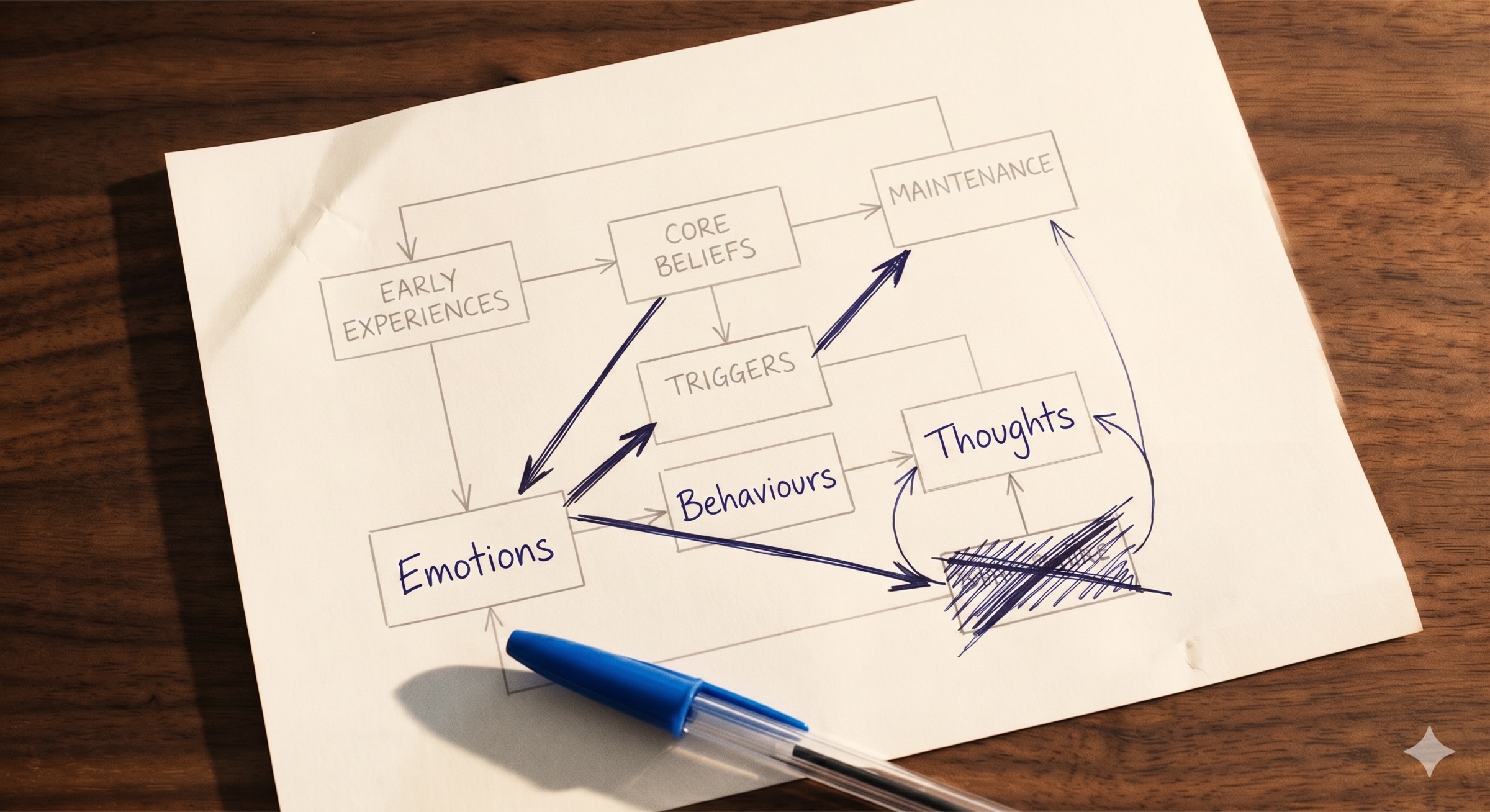
Formulation vs. Diagnosis
A diagnosis tells you what category a client fits into. A formulation tells you how their specific problems developed and what keeps them going.
Two people with "OCD" can have completely different formulations:
- One driven by responsibility beliefs
- Another by perfectionism
- Another by fear of anxiety itself
The diagnosis gives you a starting point — the formulation gives you a treatment plan.
Formulation asks: Why this person? Why these problems? Why now?
The Formulation as Shared Understanding
A good formulation isn't something you do to the client — it's something you build with them.
When a client sees their difficulties mapped out, they often have an "aha" moment: "That's exactly what happens!"
This shared understanding is therapeutic in itself:
- It normalises — "Your symptoms make sense given your learning history"
- It externalises — "It's the OCD, not you"
- It provides hope — "If we understand the mechanisms, we can change them"
The collaborative process itself is a departure from the client's experience of being told what's wrong with them or being asked to endlessly explore their past.
The Formulation as Treatment Roadmap
A good formulation tells you what to do next.
If the formulation shows that avoidance is the primary maintaining factor, you focus on exposure. If it shows that self-critical rumination is central, you target that. If early experiences created a "defectiveness" schema, you might do schema-focused work.
Without a formulation, therapy is a grab-bag of techniques applied randomly.
With a formulation, every intervention is purposeful:
"I'm doing this because the formulation suggests that changing X will improve Y."
This doesn't mean therapy becomes mechanical. The formulation guides your direction while still allowing you to respond flexibly to what emerges in session.
Formulations Evolve
The formulation is a working hypothesis, not a final verdict.
As therapy progresses, you learn more:
- The client reveals things they didn't mention in assessment
- Interventions succeed or fail, teaching you about the mechanisms
- New patterns emerge that weren't initially visible
A good therapist holds the formulation lightly, updating it as new information emerges.
The question isn't "Is my formulation correct?" but "Is it useful?" Does it help us understand and change the problem?
If not, revise it.
Types of Formulation
CBT uses different levels of formulation:
Cross-sectional formulation — a snapshot of maintaining factors in the here and now. Often a "hot cross bun" or "five areas" model showing the interaction of thoughts, feelings, behaviours, and physiology.
Longitudinal formulation — traces the development of problems from early experiences through core beliefs, assumptions, and compensatory strategies to the current presentation.
Disorder-specific formulation — applies a theoretical model (e.g., Clark's panic model, Ehlers & Clark's PTSD model) to the individual client.
The level you use depends on the complexity of the presentation and the stage of therapy. Often you start cross-sectional and go longitudinal if needed.
Common Pitfalls
1. Formulating without the client — Presenting a pre-packaged understanding rather than building it together. Even if you've "got it," the client needs to arrive at the understanding themselves.
2. Over-complex formulations — If your formulation has twelve boxes and twenty arrows, it's probably not useful. A good formulation is simple enough to hold in mind during a session.
3. Treating the formulation as fixed — Clinging to your initial conceptualisation despite evidence it's not working.
4. Skipping to techniques — Jumping into interventions before you understand what you're intervening on. Formulation-first prevents this.
Why This Matters
Formulation is what distinguishes a CBT therapist from someone who just "does CBT techniques."
It's the bridge between the theory you learn in training and the unique human being sitting in front of you. It's how you make general principles specific. It's how you know whether therapy is working.
Master formulation, and everything else follows.